Entergy wants rights across your property. Before you sign, understand what they're actually asking for.
An offer tells you what Entergy proposes to pay. The servitude, the appraisal, and the project documents tell you what Entergy proposes to take — and what that may mean for the property that remains.
Confidential review. No obligation to accept representation.
Where you are right now
You received a letter, a plat, an appraisal, or a call from a right-of-way agent.
Maybe it was a landman at your door, a packet in the mail, or an email with a deadline attached. Entergy may have already made an offer and asked you to sign and return it.
Before deciding anything, there are several separate questions worth answering — about what property rights are actually being requested, what the appraisal valued, and what the acquisition could mean for the rest of your land.
Those are questions worth answering whether or not you ever hire a lawyer.
The core distinction
The offer is only one part of the transaction.
A dollar figure is easy to react to. It's harder to see, from a single offer letter, exactly what you'd be granting in exchange — and for how long.
What they pay
Compensation
A dollar amount, sometimes broken out by right or by corridor
Usually supported by an appraisal or valuation memo
Easy to compare against a neighbor's number, a per-acre figure, or a gut sense of fairness
vs.
What you give
Property rights granted
Construction and permanent access, ingress and egress, future access
Additional circuits, structures, replacement, or expansion rights
Fiber or telecommunications rights, assignment, and sublicensing
Vegetation management and danger-tree rights, drainage, gates, fencing, restoration
The instrument — not the acreage figure on the offer sheet — defines what you're actually granting. Negotiating only the number, without reading the servitude language itself, can leave real questions unresolved.
Before you sign
What should be reviewed?
Every property and every project are different. These are the categories a property-rights review typically works through.
The Servitude
The written instrument controls — not the summary in the offer letter. Construction access, future access, assignment, additional structures, and vegetation-management rights can all be defined in language most landowners never see spelled out.
The Appraisal
An appraisal values a specific set of rights as of a specific date. Worth checking: what interest was valued, before-and-after value, highest and best use, comparable sales, and whether remainder or severance damages were analyzed at all.
The Plat & Survey
Does the plat match the legal description in the proposed instrument? Do the acreage figures in the offer correspond to what's actually staked, surveyed, and described on paper?
The Remainder
Compensation for the strip or footprint physically taken is a different question from what happens to the acreage that's left — access, drainage, fencing, farming or timber use, and future development potential.
The Project
What is the project, what alternatives to the requested rights were considered, and does the schedule create pressure to sign quickly? These questions can be asked without assuming bad faith.
The Construction Rights
Temporary work areas, laydown yards, equipment paths, and construction-period access are often broader — and can last longer — than the permanent servitude footprint suggests.
The Access Rights
Ingress, egress, and future access rights can affect parts of your property well outside the corridor or footprint where no permanent structure is ever placed.
The Restoration Terms
What is Entergy obligated to do once construction ends — topsoil, drainage, fencing, road repair — and what happens if the work isn't done to that standard?
What happens to the rest of your property?
Compensation for the footprint is not the same question as the effect on the remainder.
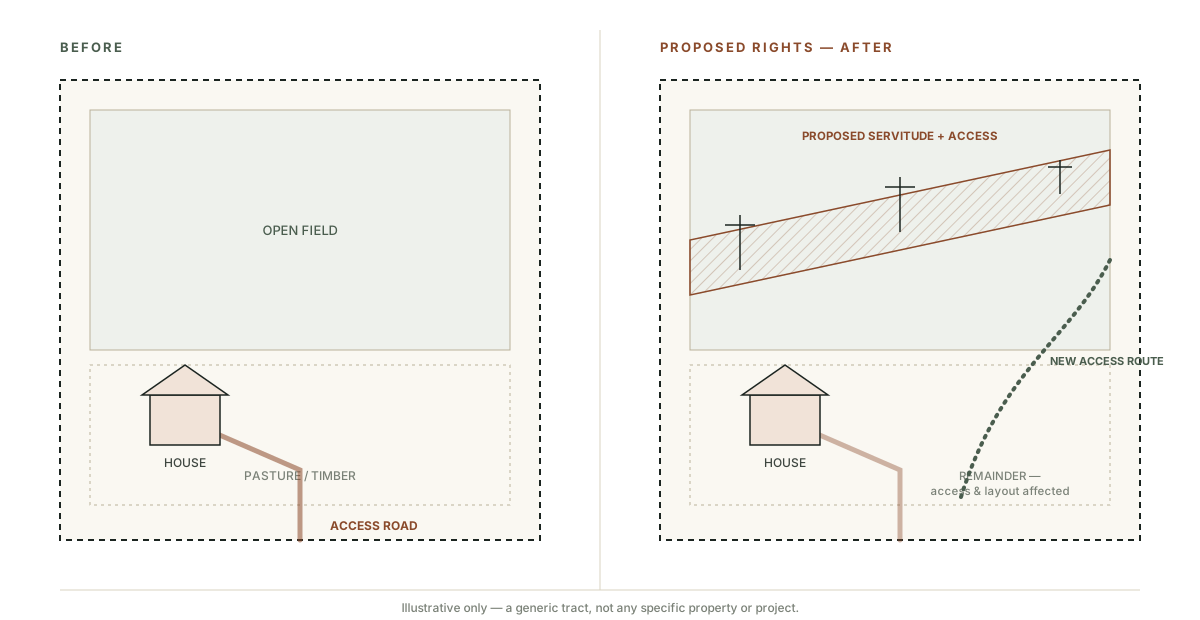
A servitude or expansion footprint can change how the rest of a tract is used, accessed, and valued — even though most of the acreage was never physically taken.
Hypothetical example — every property is different. This illustrates a generic tract and corridor, not any specific project or property.
A remainder analysis can look at things like:
Division of usable acreage and changes to internal layout
Interference with access, internal roads, or a development plan
Drainage, fencing, and agricultural or timber operations
Effects during construction versus effects that are permanent
Marketability and how a future buyer might perceive the configuration
Limitations created by the specific rights granted, not just the acres taken
Before you sign anything
Questions worth asking
What rights does the servitude actually grant — not just how many acres are shown?
Does the appraisal value the same rights the proposed agreement asks you to convey?
Did the valuation consider the property that remains, or only the footprint taken?
Could the project affect access, drainage, fencing, timber, agricultural use, or future development?
Are transmission, fiber, construction, and access rights being valued separately, or lumped into one number?
What future rights — expansion, additional circuits, replacement facilities — does the proposed instrument grant?
Does the plat match the written legal description in the agreement?
What happens if the project's scope or schedule changes after you sign?
How a review works
Our review process
Procedural, not adversarial. The goal is an informed decision — yours.
1
Send us what Entergy sent you
The offer letter, any proposed servitude or agreement, an appraisal if one was provided, a plat or survey, and any deadline or correspondence.
2
We identify the rights and documents involved
We separate what's actually being requested — transmission rights, fiber rights, construction access, future access — so each can be evaluated on its own terms.
3
We review the offer, appraisal, and property impacts
Including what was valued, what wasn't, and what the acquisition could mean for the remainder of the property.
4
We explain the options
In plain language — what the evidence supports, what's still unclear, and what the realistic paths forward look like.
5
You decide what to do
You control whether to accept an offer, negotiate further, or proceed differently. Nothing is signed or filed on your behalf without your authority.
Entergy Offer Review
Let us review what Entergy sent you.
Share what you've received and we'll identify the issues that may deserve a closer look. This does not create an attorney-client relationship and does not commit you to representation.
Confidential
No obligation
Plain-language response
Why Winch Law Firm
Property-rights cases are document cases, valuation cases, engineering cases, and evidence cases.
Our approach to an Entergy acquisition is to work through the same questions in the same order, every time:
What rights are actually being sought — read against the instrument itself, not the summary offer letter.
What those rights mean operationally — for access, construction, maintenance, and future use.
What was actually valued — and whether the appraisal addressed the remainder, not just the footprint.
What may happen to the remainder — access, drainage, farming or timber use, and marketability.
What evidence supports the property owner's position — deeds, surveys, photographs, use history, and expert analysis.
What information is still missing — and how to request it in an organized, documented way.
We're a Louisiana firm focused on property rights and complex civil litigation. We don't promise a result before we've reviewed the documents — because no one honestly can.
Frequently asked questions
Questions landowners ask us
Can Entergy expropriate private property in Louisiana?
Louisiana law permits a public utility such as Entergy to expropriate certain property rights for qualifying purposes, following a statutory procedure and subject to the constitutional requirement of just compensation. Whether expropriation is legally available for a given project depends on the specific facts, the rights sought, and the applicable law — it isn't automatic simply because a project has been proposed.
Do I have to accept Entergy's first offer?
No. An initial offer is a starting point, not a final determination of value. Whether it reflects the property's value depends on the appraisal methodology used, exactly which rights are being acquired, and whether effects on the remainder were considered.
Should I sign before the deadline on the letter?
A deadline in a letter is not, by itself, a legal requirement that you sign by that date. Before signing anything, it's worth understanding what you'd be granting and whether the compensation and instrument reflect a full evaluation of the rights involved. If you're concerned about a deadline, that's worth raising with whoever is reviewing your documents right away.
What is a servitude?
Under Louisiana law, a servitude is a real right that burdens one property (or a landowner's rights in it) for the benefit of another person or entity — similar to what other states call an easement. A transmission or utility servitude typically grants specific rights, such as the right to construct, operate, and maintain facilities, which can include related rights like access, vegetation management, or future expansion, depending on how the instrument is written.
What are severance damages?
Severance damages (sometimes discussed as remainder or "before and after" damages) refer to a decrease in value to the property that isn't physically taken, caused by the taking of a portion of the tract or the rights granted over it. Whether severance damages apply, and how much, depends on the property, the project, and the appraisal evidence — it isn't automatic in every case.
What if Entergy already has an easement on my property?
An existing easement or servitude may or may not cover the new rights being requested — additional circuits, fiber, expanded access, or a wider corridor, for example, may go beyond what was originally granted. Comparing the existing recorded instrument to what's currently being requested is one of the first things worth checking.
What if the project only affects a small part of my land?
The size of the physical footprint is a different question from the size of the effect. A small footprint in the wrong location — across a driveway, through a drainage path, or splitting a field in half — can affect the usability of a much larger area. It's worth evaluating regardless of how many acres are directly involved.
What should I send you?
Whatever Entergy has actually sent you: the offer letter, any proposed servitude or easement, an appraisal if one was provided, a plat or survey, and any correspondence mentioning a deadline. If you don't have all of these, send what you have — we'll tell you what else may be useful.
Will contacting a lawyer automatically start a lawsuit?
No. Most property-rights matters involving a utility acquisition are resolved, or at least substantially clarified, before any lawsuit is filed. Contacting a lawyer for a document review is a way to get informed — it does not commit you to litigation, and any decision about how to proceed remains yours.
Before you sign away property rights, understand them.
Send us what Entergy sent you. We'll tell you what we see.